
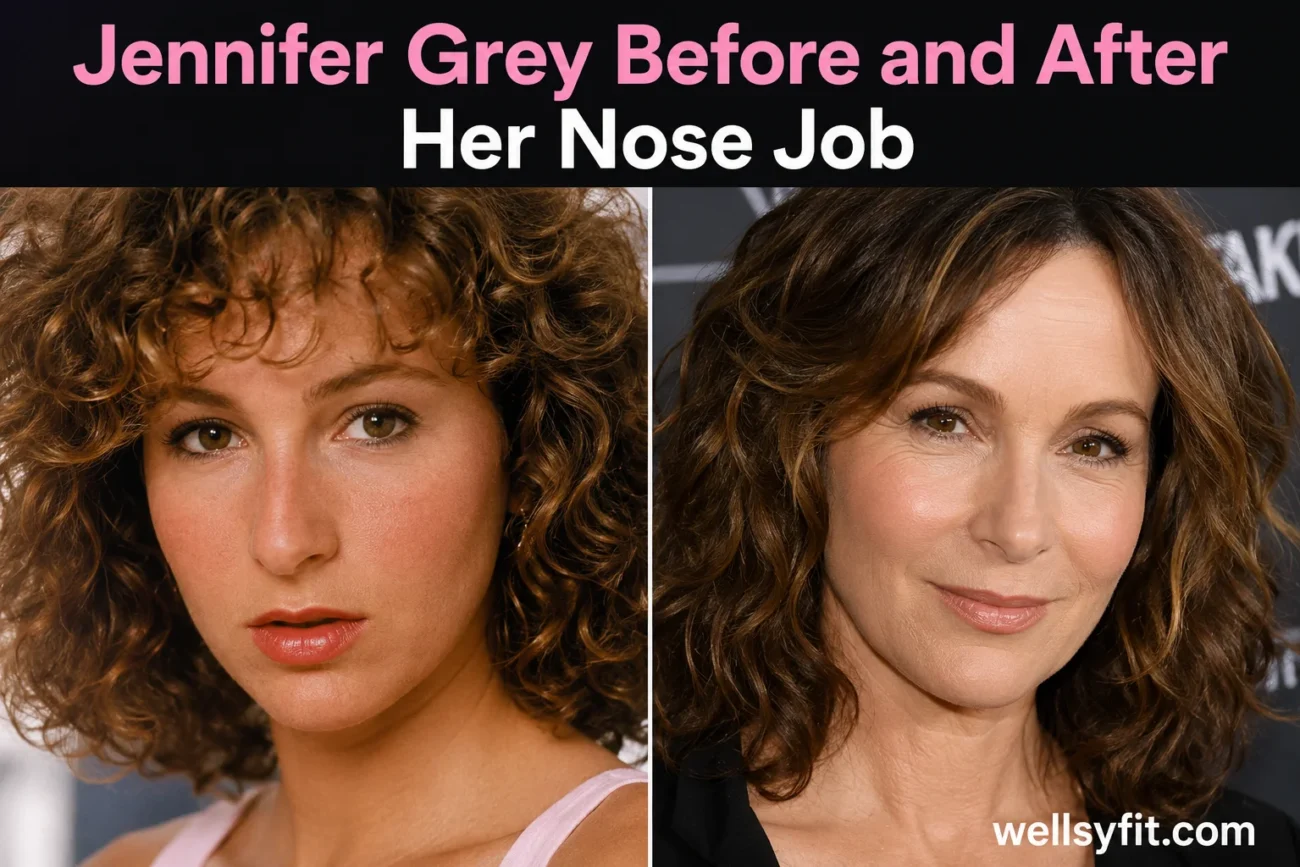
Jennifer Grey walked into the operating room as one of the most recognizable faces in Hollywood and came out a stranger to her own career. Her rhinoplasty, undertaken in the early 1990s after the massive success of Dirty Dancing, is now one of the most discussed cautionary tales in the history of celebrity cosmetic surgery. Not because the surgery went medically wrong, but because it worked exactly as intended, and in doing so, erased the very features that had made her famous.
Who Jennifer Grey Was Before the Nose Job
To understand the full weight of what happened after her rhinoplasty, it helps to understand exactly where Jennifer Grey stood before it. Born on March 26, 1960, in New York City, she grew up in a family embedded in show business. Her father, Joel Grey, won both a Tony Award and an Academy Award for his role in Cabaret. Talent was never the question for Jennifer Grey. Opportunity was.
Her early career included a supporting role in Red Dawn in 1984 and a memorable turn as Jeanie Bueller in Ferris Bueller’s Day Off in 1986. Both roles showed her comedic timing and screen presence. But it was her lead role as Frances “Baby” Houseman in Dirty Dancing in 1987 that turned her into a genuine star. The film became a cultural phenomenon, earning over 214 million dollars worldwide against a budget of just 6 million. Grey received a Golden Globe nomination for her performance. She was, by every measure, one of the most promising actresses of her generation.
Her face was part of her identity in a specific and meaningful way. The bump on the bridge of her nose was distinctive. It was the feature that made her look like a real person rather than a Hollywood prototype, and audiences connected with that. What came next would erase that connection entirely.
The Decision to Have Rhinoplasty
Jennifer Grey has been consistent and candid about the fact that she did not want the surgery. In interviews promoting her 2022 memoir Out of the Corner, she described herself as having been “completely anti-rhinoplasty” for most of her life, saying she believed she was “beautiful enough” and that getting the surgery would mean “surrendering to the enemy camp.”
The pressure came from multiple directions. Her mother, actress Jo Wilder, had suggested she alter her nose from early on. Hollywood casting culture in the 1980s carried its own set of unspoken expectations. Grey, who is of Jewish descent, has spoken about the cultural pressure she felt around her nose specifically, describing a sense of “self-loathing” that the industry attached to certain natural features. She has also said she was told, in various ways, that her nose was “a problem” for the kinds of roles she might otherwise access.
After Dirty Dancing, rather than opening every door as she had hoped, she found the industry still limited in what it offered actresses who looked like her. That gap between her success and her opportunities contributed to the decision she had resisted for years.
The First Surgery and Why a Second Followed
Grey underwent her first rhinoplasty in the early 1990s. By her own account, she was initially pleased with the results and described working consistently in the period that followed. The problem emerged when she noticed irregularities in the outcome of the first procedure. A second surgery was performed to correct those issues, and it was the second surgery that produced the dramatic change in her overall appearance.
The combination of both procedures removed the distinctive bump on the bridge of her nose and reduced the size of the nasal tip. The result was a nose that was, by conventional standards, more refined. By the standards of the face it now sat on, it was unrecognizable. Features do not exist in isolation. Changing one significant feature changes the entire way a face reads, and what had made Jennifer Grey’s face distinctive and memorable was precisely the relationship between all its parts. That relationship was altered.
What Jennifer Grey Looked Like After: The Physical Change
The difference between Jennifer Grey before and after her nose job has been widely noted and discussed for decades, and it goes beyond a simple before-and-after comparison. Before the surgeries, her face had a distinctiveness that casting directors, audiences, and photographers immediately associated with her. After the surgeries, that immediate recognition was gone.
The physical changes included a significantly reduced nasal bridge, the removal of the natural bump that had been her most recognizable feature, and a smaller, more conventionally shaped nasal tip. The result looked natural on its own terms. The challenge was that it no longer looked like Jennifer Grey. Her eyes, her cheekbones, and her overall facial structure remained the same, but without the nose that had anchored all those features together in a familiar way, the overall impression was of a different person.
This phenomenon is not unusual in rhinoplasty. According to the Mayo Clinic, rhinoplasty can change the shape, size, angle, and proportions of the nose, and even subtle changes can significantly affect the overall balance of facial features. When a distinctive feature is central to how someone is recognized, altering it does not simply change one element. It changes the entire visual signature of that face. In Jennifer Grey’s case, that visual signature was known to millions of people worldwide.
The Career Impact: From Hollywood Star to Anonymous
The career consequences of Jennifer Grey’s nose job are among the most documented in Hollywood history. What makes her case particularly striking is the speed at which it happened. This was not a gradual fading from public consciousness. It was a near-immediate disconnection between a known actress and the face people associated with her name.
In her memoir, Grey describes attending a press event shortly after recovering from the second procedure. Paparazzi who would previously have followed her did not raise their cameras. At an airport, an airline employee looked at her identification, noted the name Jennifer Grey, and said the line that has since become the defining anecdote of her story: “I’ve seen Dirty Dancing a dozen times. I know Jennifer Grey. And you are not her.” Grey replied that it was in fact her. The employee did not believe her.
She also recalled attending a premiere where her longtime friend Michael Douglas did not recognise her. As she wrote in Out of the Corner, the experience was disorienting in a way that went beyond professional setback: “Overnight I lose my identity and my career. In the world’s eyes, I was no longer me.”
The acting roles that had seemed inevitable after Dirty Dancing did not materialise. Casting directors who might have recognised her name could no longer match it to a face. The particular kind of relatability that had made her compelling on screen, rooted in part in her distinctive appearance, was no longer visible. The broader conversation around public scrutiny over a celebrity’s physical appearance rarely accounts for the professional consequences that can follow when that appearance changes dramatically.
The Years That Followed
Grey’s career did not end entirely, but its trajectory changed fundamentally. She moved toward supporting roles, guest appearances on television, and voice work. She appeared in episodes of Friends and Grey’s Anatomy, and had a recurring role in the short-lived sitcom It’s Like You Know, in which she played a fictional version of herself. These were creditable credits, but they were not the leading-role career that her pre-surgery momentum had made plausible.
The shift mirrored something that other public figures who have spoken openly about body image have described in different ways: the gap between what a physical change was supposed to deliver and what it actually cost. In 2010, Grey returned to wide public attention by competing on and winning Dancing With the Stars, a moment that reintroduced her to audiences on her own terms. It was also the experience that planted the seed for writing her memoir.
Jennifer Grey on Rhinoplasty: Her Own Words
When Grey published Out of the Corner in May 2022, she addressed the rhinoplasty directly and at length. The memoir begins with a seventeen-page prologue focused on her nose and the surgeries that changed her life. That choice of opening was deliberate. She was not easing readers into the subject. She was leading with it.
In interviews with the New York Times and People magazine conducted around the memoir’s release, she described the surgery as something she had resisted for years before finally relenting under accumulated pressure. She referred to the aftermath of the second procedure as “schnozzageddon” in the memoir, a term that captures both the scale of the change and the dark humour she has developed around it over time.
Her most reflective statements were about accountability. Rather than positioning herself purely as a victim of industry pressure, she acknowledged the role her own choices played. “I spent so much energy trying to figure out what I did wrong, why I was banished from the kingdom,” she told People. “That’s a lie. I banished myself.” That level of honest self-examination is part of what has made her story resonate beyond celebrity gossip into something more substantive about identity, choice, and the stories people tell themselves. The way Hollywood beauty standards shape real-world decisions for women in entertainment is a conversation her memoir contributed to directly.
What Rhinoplasty Actually Involves
Jennifer Grey’s experience has made her one of the most referenced examples in discussions about rhinoplasty outcomes, and understanding what the procedure involves adds context to why the results in her case were so consequential.
Rhinoplasty is one of the most performed cosmetic surgeries in the world. According to the American Society of Plastic Surgeons, rhinoplasty consistently ranks among the top five cosmetic surgical procedures performed annually in the United States. The procedure involves reshaping the bone and cartilage of the nose and can address size, shape, angle, and symmetry. Results are permanent.
Surgeons who specialise in rhinoplasty consistently emphasise the importance of preserving what makes a face distinctive rather than simply applying a standardised idea of a smaller or more refined nose. The most technically successful rhinoplasty in isolation can produce an outcome that reads as wrong in the context of the face it belongs to. This is precisely what happened with Jennifer Grey. Her surgeries were not botched in a medical sense. They were completed as intended. The consequence was not a surgical error but a fundamental change to the visual identity of a face that millions of people knew well.
The Broader Lesson Her Story Carries
Jennifer Grey’s before and after transformation is discussed so frequently because it illustrates something that statistics and surgical descriptions cannot fully convey. A face is not a collection of individual features that can be adjusted independently. It is a system. When one element that defines the whole is changed, the whole changes with it.
For anyone in the public eye, that change is absorbed not just personally but by everyone who knew the original face. For Grey, those people numbered in the tens of millions. The paparazzi who did not raise their cameras were not being unkind. They simply did not recognise her. The airline employee who refused to believe she was Jennifer Grey was not being difficult. She was responding honestly to a face that did not match the name.
What Grey has done with that experience in her memoir is arguably more interesting than the surgery itself. She has reframed it not as something that was done to her but as a choice she made under pressure, and she has taken ownership of both the decision and its consequences. That reframing required, by her own account, decades of work.
Frequently Asked Questions
Disclaimer: Content on WellsyFit is for informational purposes only and does not replace professional medical advice. Always consult a healthcare provider.