
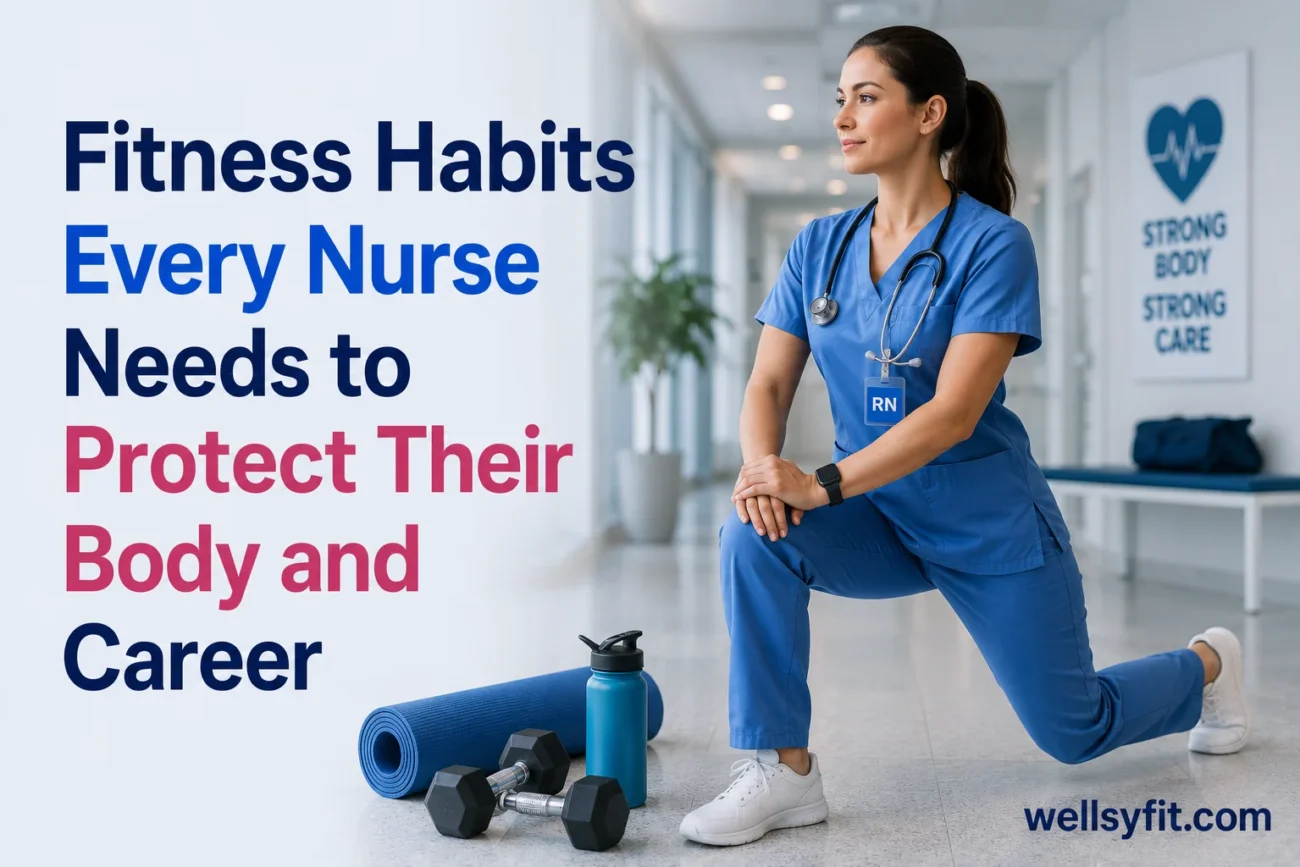
A nurse takes a few minutes between shifts to stretch – a habit that pays off over a long career
Nurses spend their careers keeping other people healthy. The irony is that the job itself is one of the hardest on the human body. Twelve-hour shifts, constant movement, patient lifting, and the mental weight of high-stakes decision-making don’t add up to a lifestyle that naturally supports long-term physical health.
The common assumption is that nurses are active enough already. They’re on their feet all day. They walk miles per shift. Surely that counts. It doesn’t – not in the way the body needs to stay resilient. There’s a meaningful difference between movement that depletes and training that builds. Most nurses are stuck in the first category.
This isn’t about gym culture or weight loss. It’s about occupational survival. Nurses who build intentional fitness habits outside of work don’t just feel better – they’re less likely to get hurt, less likely to burn out, and more likely to stay in a profession that desperately needs them.
Why Nurses Are More Physically Vulnerable Than Most

The body parts most affected by nursing workload: lower back, knees, and shoulders bear the heaviest load across a 12-hour shift
Nursing carries a level of physical risk that most people outside healthcare don’t appreciate. Musculoskeletal disorders account for roughly 46% of all occupational injuries among nurses, according to 2025 data compiled by WifiTalents citing multiple peer-reviewed studies. Global prevalence of work-related musculoskeletal conditions among nurses ranges from 60% to 98%, and each injury results in an average of 7 days off work.
Then there’s burnout. According to the Nurse.com 2026 Nurse Salary and Work-Life Report, which surveyed more than 500 nurses between September and October 2025, 53% reported experiencing burnout in the previous two years, 62% felt overwhelmed, and 24% are actively considering leaving the profession.
These numbers don’t exist in a vacuum. The U.S. currently faces a deficit of approximately 295,800 registered nurses, according to HRSA and the NSI National Health Care Retention and RN Staffing Report 2025. With that many positions unfilled, the nurses who remain absorb a disproportionate share of the physical workload. Working with a healthcare staffing company is one way facilities try to close that gap – connecting understaffed units with qualified nurses on demand – but for the nurses already on the floor, the daily physical pressure doesn’t wait for a staffing solution.
The body wears down faster when you’re chronically understaffed and chronically under-recovered. Intentional fitness is one of the few things a nurse can control.
What “Getting Enough Exercise” Actually Means for a Nurse

Planning workouts with the same intention as planning shift schedules makes the habit stick more reliably
The CDC’s physical activity guidelines for adults call for at least 150 minutes of moderate aerobic activity per week plus 2 strength training sessions. That recommendation doesn’t adjust for how physically demanding someone’s job is. A nurse who walks six miles during a shift is still starting from zero when it comes to intentional exercise.
This distinction matters. Walking during a shift depletes the body – it’s functional movement under cognitive and physical stress, with interrupted recovery and no progressive training stimulus. Intentional exercise builds the body – it increases strength, improves cardiovascular capacity, and trains the neuromuscular patterns that reduce injury risk.
A 2025 PMC study of 430 nurses at Hamad Medical Corporation in Qatar found that 46.5% reported low physical activity outside of work – despite being on their feet throughout every shift. The nurses with moderate physical activity outside work had measurably higher compassion satisfaction scores (40.3 vs. 36.9 for the low-activity group). Being physically active away from work protected their professional quality of life, not just their bodies.
The goal isn’t to exercise on top of exhaustion. It’s to use some off-shift windows for active recovery rather than purely passive rest.
The Best Workout Types for Shift Workers
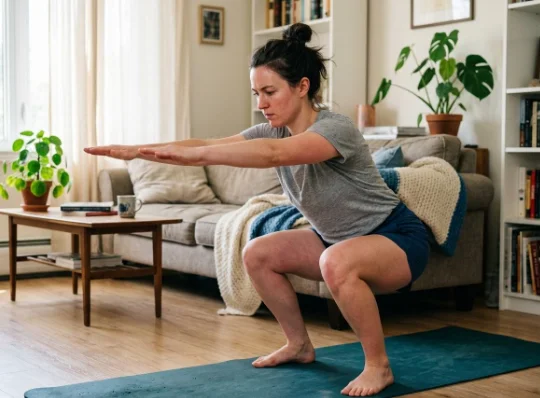
Bodyweight workouts done at home are practical for nurses who can’t commit to a gym schedule or fixed workout times
Not all exercise formats work equally well for rotating shift schedules. Three types stand out for nurses specifically.
Strength training, done twice a week, targets the muscle groups that nurses rely on most. OSHA’s guidance on reducing musculoskeletal disorders in healthcare highlights that the back, shoulders, and core are the primary injury sites in patient handling. Compound movements – deadlifts, Romanian deadlifts, rows, and planks – directly address those areas. Two 30-minute sessions per week are enough to build real protective strength. You don’t need a barbell or a gym.
High-intensity interval training (HIIT) takes 20-30 minutes and builds cardiovascular fitness without the time investment of longer steady-state cardio. For a nurse with unpredictable off-shift windows, a 25-minute HIIT session is far more realistic than a 60-minute run. Research consistently shows that HIIT produces similar cardiovascular adaptations in a fraction of the time.
Yoga and mobility work function as active recovery between shift blocks. They’re not the main event, but they’re not optional either. A 20-minute mobility routine on the evening before a shift block reduces muscle stiffness, improves range of motion, and takes the edge off the soreness that accumulates over a run of 12-hour days.
One honest limitation: strength training requires some equipment, even if minimal. A resistance band set and a pair of dumbbells cover most exercises. That’s a one-time purchase, not a gym membership.
Fitting Workouts Into a Schedule That Changes Every Week
The practical challenge with nursing schedules isn’t motivation – it’s structure. Most fitness advice assumes a fixed weekly calendar. Nursing doesn’t have one.
The solution is to anchor workouts to shift patterns rather than days of the week: strength on the first day off after a shift run, HIIT on the second or third off day when energy has returned, and mobility or yoga the evening before a new shift block. Avoid working out within 3-4 hours of a night shift start – exercise raises cortisol and body temperature, both of which interfere with the sleep that follows.
The long view matters too. According to the NSI National Health Care Retention and RN Staffing Report 2025, 40% of nurses intend to leave the workforce by 2029. The ones who stay will carry heavier workloads. Treating your physical health as a professional asset is how you make nursing sustainable long-term. Our piece on how nurses can adapt to a changing healthcare world covers the broader picture of what that sustainability looks like.
Eating and Sleeping Around Shifts
Fitness habits without nutrition and sleep support are half-measures. For nurses, both are complicated by shift timing.
Protein is the most direct nutritional lever. Muscle repair after physically demanding work requires adequate protein – the general recommendation for active adults is 1.6-2.2 grams per kilogram of body weight daily. For most nurses, that means aiming for more protein than they’d naturally eat when grabbing whatever’s available between patients. Our piece on protein intake and muscle recovery covers how protein specifically supports repair after demanding physical work. Preparing meals 2-3 days ahead of a shift block solves both the timing and the vending-machine problem.
Sleep is the variable most nurses sacrifice first, and it’s the worst trade. Sleep deprivation increases injury risk, impairs decision-making, and undermines the training adaptations that exercise is supposed to produce. On genuinely exhausted recovery days, choosing sleep over a workout is the right call – not an excuse, a physiological priority.
The Mental Health Case for Nurse Fitness
The physical argument for exercise is clear. The mental health case is just as strong, and it’s backed by data specific to nurses.
The 2025 PMC study in Qatar found that nurses with moderate physical activity outside work had notably higher compassion satisfaction scores than colleagues with low activity levels. The Wisconsin Nurses Association, citing research from the Journal of Occupational and Environmental Medicine, also links regular physical activity among nurses to reduced burnout and better mental health outcomes. Exercise functions as a real buffer against burnout – not a cure, but an intervention nurses can act on independently.
Our article on why nurses pursue advanced practice roles examines how career trajectory and physical endurance are more tightly linked than most nursing programs acknowledge.
Starting Small: A Realistic First Week
The biggest barrier to starting isn’t knowledge – it’s the exhaustion that follows a run of 12-hour shifts. Beginning with an ambitious five-day plan guarantees failure. Starting with two sessions is achievable.
Week one: one 25-minute strength session built around bodyweight squats, Romanian deadlifts with a resistance band, push-ups, and planks. One 20-minute mobility session with hip flexor stretches, thoracic rotations, and a basic hamstring sequence. That’s it. The goal in week one isn’t intensity – it’s showing up twice. Consistency over months produces results. Trying to do too much in week one produces soreness and a reason to quit in week two.
One regular session per week, maintained for six months, produces measurably better outcomes than a perfect plan that collapses after two weeks.
Your Body Is Your Career
Nurses are trained to prioritize everyone else’s physical health. That professional instinct is exactly what makes self-care difficult – there’s always a more pressing need for someone else.
But the nursing shortage isn’t getting better quickly. The workloads nurses carry now are likely to grow heavier, not lighter, in the years ahead. Physical resilience isn’t a personal choice that exists separately from professional performance. It determines how long a nurse can keep doing this work, and how well.
The habits that matter most aren’t complicated. Strength training twice a week. Some form of cardiovascular exercise. Adequate protein. Sleep treated as non-negotiable. These aren’t wellness trends. They’re occupational maintenance – the equivalent of a pilot reviewing checklists before a flight.
None of this requires a gym membership, a personal trainer, or a radical lifestyle change. It requires two to three hours per week outside of work, treated with the same seriousness that nursing brings to everything else.
Disclaimer: Content on WellsyFit is for informational purposes only and does not replace professional medical advice. Always consult a healthcare provider.