
If you have ever seen your toddler go completely still-eyes glazed, mouth slightly open, and unresponsive to their own name-you have witnessed the “Cocomelon Trance.” While the show is a global phenomenon, a growing number of parents and experts are raising alarms about its impact on critical brain development. If you are asking why is cocomelon bad for kids, the answer lies in the intersection of fast-paced animation, dopamine loops, and sensory overstimulation.
The Science of Hyperstimulation: A Digital Dopamine Hit
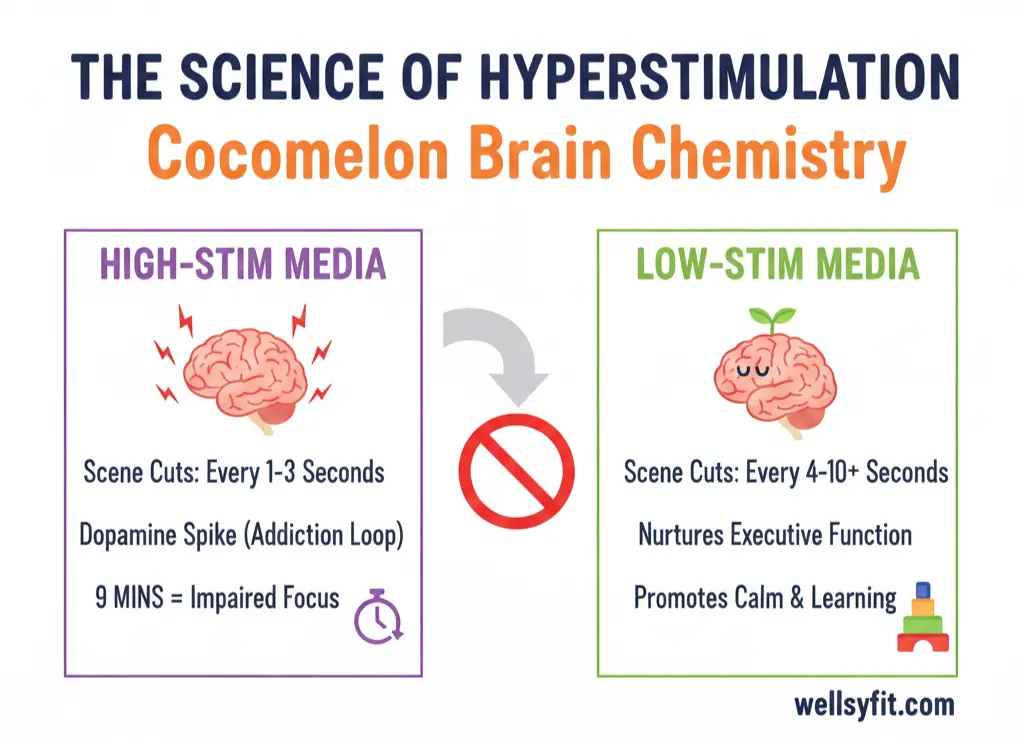
To understand why this show is so polarizing, we have to look at how it interacts with a child’s prefrontal cortex. Unlike traditional children’s programming, this show is a masterclass in hyperstimulation. It utilizes high-contrast, saturated colors and incredibly fast-paced editing to maintain a child’s attention.
Research suggests that the dopamine reward system in a toddler’s brain is highly sensitive. When a child watches a show that changes scenes every 1 to 3 seconds, the brain receives a constant “hit” of dopamine. This creates a cycle where the child becomes “addicted” to the high-stimulus environment. When the screen is finally turned off, the sudden drop in dopamine often results in what parents describe as “French Revolutionary-level” tantrums.
The 2-Second Rule and Executive Function
A pivotal study published in the journal Pediatrics found that just 9 minutes of exposure to fast-paced media can immediately impair a child’s executive function. This includes their ability to stay organized, follow directions, and control impulses.
| Feature | CoComelon (High-Stim) | Slow-Paced Media (Low-Stim) |
| Scene Cuts | Every 1–3 Seconds | Every 4–10 Seconds |
| Color Palette | Neon, Highly Saturated | Natural, Muted Tones |
| Camera Movement | Constant Panning/Zooming | Steady, Fixed Shots |
| Impact | May trigger hyperstimulation | Encourages reflective thinking |
Does CoComelon Cause Speech Delay?
One of the most frequent concerns parents have is whether cocomelon causes speech delay. While the show features nursery rhymes and repetitive lyrics, the way the information is delivered matters. For language to be “learned” by a toddler, it usually requires a concept called Joint Attention-the shared focus of two individuals on an object.
The fast-paced nature of the show often leads to visual overload, where the child is so overwhelmed by the moving colors that they stop processing the phonetic sounds. Some experts have noted an increase in echolalia-where a child repeats words without understanding their meaning-rather than developing functional communication.
Neuroplasticity in the early years is a “use it or lose it” system. If a child spends their peak learning hours in a passive viewing state, they miss out on the “back-and-forth” social interaction required for healthy speech milestones.
The Sensory Processing Trap
For children with Sensory Processing Disorder (SPD) or those who are neurodivergent, the “Cocomelon effect” is amplified. These children often have a lower threshold for sensory flooding. The constant auditory and visual input acts as a “bottom-up” sensory attack, leaving the child’s nervous system in a state of high alert.
This is why many parents report that their toddlers seem “wound up” or hyperactive after watching. The brain is struggling to process the sheer volume of data, leading to Technoference—the interference of digital media with daily human connection and emotional regulation.
“The issue isn’t necessarily the content; it’s the delivery. We are feeding toddlers ‘digital candy’ and then wondering why they have a sugar crash when the show ends.” Expert Consensus
The 7-Day “Cocomelon Detox” Protocol
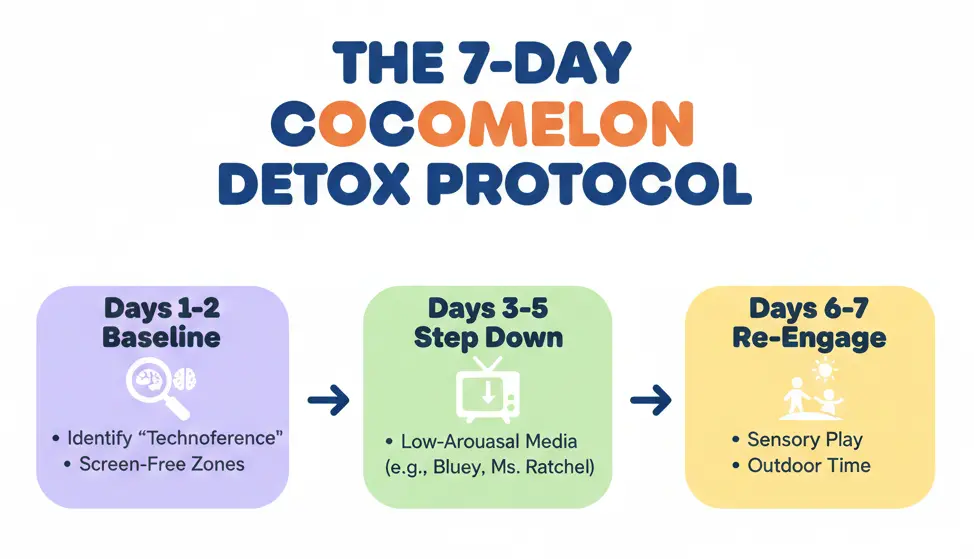
If you’ve noticed your child is struggling with post-show meltdowns, it may be time for a media reset. Transitioning away from high-stimulus shows doesn’t have to be a battle.
Phase 1: Identifying the Baseline
Start by observing your child’s behavior. Are they blinking less while watching? Do they ignore you when you speak? These are signs of a cognitive refractory period, where the brain is so locked into the screen it cannot disengage.
Phase 2: The Step-Down Method
Instead of going “cold turkey,” transition to low-arousal media. Look for shows that have a slower frame rate, more natural colors, and characters that speak directly to the camera with pauses for the child to respond.
Phase 3: Sensory Re-Engagement
Replace the screen time with high-tactile activities. Sensory bins, water play, or outdoor exploration help “ground” the child’s nervous system and rebuild the neural pathways associated with physical play.
2026 Pediatric Guidelines for Digital Hygiene
As we navigate a digital-first world, the latest guidelines emphasize quality over quantity. The AAP Guidelines suggest that for children under 18 months, screen time should be avoided entirely, with the exception of video chatting with family.
For children aged 2 to 5, a limit of 1 hour per day is recommended, but with a catch: it should be active viewing. This means a parent sits with the child, asks questions, and connects the screen content to the real world. This turns a passive “trance” into a learning opportunity.
Important Note: Avoid all screens at least 60 minutes before bedtime. The blue light and high-stimulus pacing can suppress melatonin, leading to sleep disturbances and further irritability the next day.
Conclusion: Balancing Entertainment and Development
So, is the show “evil”? No. But it is a powerful tool that should be used with caution. The reason why is cocomelon bad for kids in large doses is that it bypasses the child’s natural pace of learning and replaces it with an artificial, hyper-fast reality.
By prioritizing low-stim alternatives and ensuring that media is a small part of a sensory-rich day, you can protect your child’s developing brain while still enjoying the convenience of modern technology.
FAQs About Why Is Cocomelon Bad for Kids
Disclaimer: Content on WellsyFit is for informational purposes only and does not replace professional medical advice. Always consult a healthcare provider.