
If your child suddenly “can’t go to school” on the morning of a big test, you’re not imagining the suspicious timing. Most parents have been there — hand on the forehead, thermometer in hand, trying to figure out if this is real or a very convincing performance.
Here’s the short answer: a true fever means a temperature of 100.4°F (38°C) or higher, measured accurately with a thermometer. If the reading is normal and the symptoms seem to vanish the moment the TV turns on, there’s a good chance your child is playing sick.
But it’s not always that simple. Below are the clearest signs to watch for, how to get an accurate temperature reading, and what to actually do when you suspect your child is faking it.
The Clearest Signs Your Child Is Faking a Fever
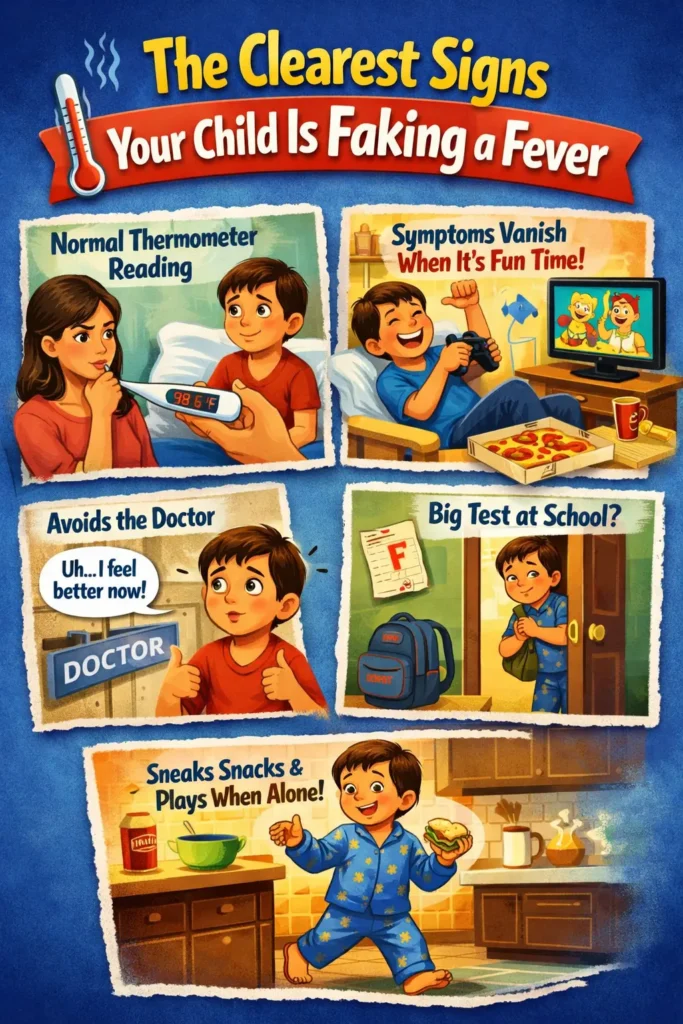
1. The Thermometer Reads Normal (Every Time)
This is the most reliable check you have. A fever cannot be faked on an accurate thermometer — a child’s internal body temperature either is elevated or it isn’t.
The trick is taking the temperature correctly:
- Don’t let your child eat or drink anything hot or cold for 15–20 minutes before a mouth reading — warm tea or cold juice can skew the result.
- Avoid taking their temperature right after they’ve been running around or bundled under heavy blankets, as physical activity and excess warmth can produce a slightly higher reading.
- A digital thermometer is the most reliable option for home use. For children under three months, always check with a pediatrician regardless of the reading.
If you take the temperature under controlled conditions and it comes back below 100.4°F, the “fever” is almost certainly not real.
2. Symptoms Disappear Conveniently
Real illness tends to be consistent. A child with a genuine fever feels miserable, moves slowly, loses interest in food, and often drifts in and out of sleep even when left to watch TV.
Red flags that suggest faking:
- They were “burning up” an hour ago but are now laughing at cartoons or scrolling their phone with full energy.
- The symptoms seem to shift around — first a headache, then a stomachache, then a sore throat — without a clear pattern.
- They perk up noticeably the moment you say “I guess you can stay home.”
Vague, migrating symptoms are a classic indicator. As one school nurse with 15 years of experience put it, when complaints jump from “my head hurts” to “now my elbow and stomach hurt,” that’s a signal worth noting.
3. They’re Reluctant to See a Doctor
This one is telling. A child who is genuinely sick usually doesn’t object to a doctor’s visit — they want to feel better. A child who is faking it knows the doctor will see through it immediately.
If suggesting a doctor’s appointment produces a sudden, dramatic recovery, you have your answer.
4. They Have a Known Reason to Avoid School
Think about what’s happening at school that day. Is there:
- A test or project due?
- A presentation they’re anxious about?
- A conflict with a classmate or teacher?
Research suggests around 10% of school-age children try to fake illness to get out of school at some point. It’s worth asking yourself whether there’s a specific trigger — not to dismiss the complaint, but to understand it.
5. Normal Appetite, Normal Energy (In Private)
Kids with real fevers don’t want to eat. They feel weak, achy, and uncomfortable. If you notice your child quietly raiding the kitchen when they think you’re not watching, or showing bursts of their usual energy when they think the performance is over, that’s a meaningful sign.
How to Take an Accurate Temperature
Before concluding anything, take the temperature properly. Here’s a quick guide:
| Method | Best For | Notes |
|---|---|---|
| Oral (mouth) | Children 4+ | No hot/cold drinks 15 min before |
| Rectal | Infants | Most accurate for babies |
| Temporal (forehead) | All ages | Convenient but slightly less precise |
| Tympanic (ear) | 6 months+ | Reliable when used correctly |
| Axillary (armpit) | Quick check only | Least accurate; not recommended for diagnosis |
A reading below 100.4°F (38°C) is considered normal. Anything at or above that threshold is generally defined as a true fever by pediatricians.
What to Do When You Suspect Faking
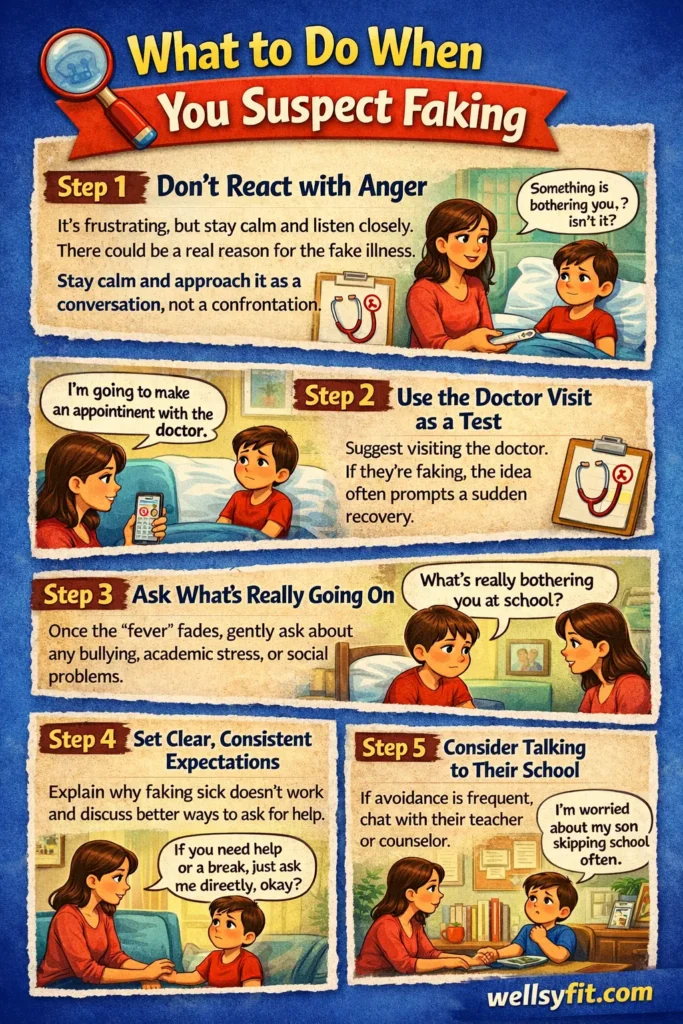
Step 1: Don’t React with Anger
It’s frustrating, but getting angry rarely helps. Children fake illness for a reason — sometimes it’s laziness, but often it’s anxiety, stress, or something happening at school that they don’t know how to talk about directly.
Stay calm and approach it as a conversation, not a confrontation.
Step 2: Use the Doctor Visit as a Test
Calmly say: “You’re not feeling well, so I’ll make an appointment with the doctor today.”
If your child’s “illness” evaporates on the spot, you’ve confirmed your suspicion without any drama. If they maintain the complaint, the visit will either confirm they’re actually sick or let the doctor do the reality check for you.
Step 3: Ask What’s Really Going On
Once the performance is over, sit down and ask directly but gently: “Is there something happening at school that’s worrying you?”
Children who fake illness repeatedly are often dealing with something more than just wanting a day off. Common underlying causes include:
- Bullying — physical or social
- Test anxiety or academic pressure
- Social difficulties — friendship problems, feeling left out
- Anxiety disorders, which can cause real physical symptoms like stomachaches and headaches
- Depression, especially in older children and teens
The physical symptoms may not be entirely fake in these cases — anxiety genuinely causes stomach pain, headaches, and nausea. What’s happening is that the distress is real, even if the fever isn’t.
Step 4: Set Clear, Consistent Expectations
If you confirm the illness was fabricated, address it directly. Let your child know that faking sick is not a reliable strategy, and that there are better ways to ask for help or a break.
At the same time, make sure they know they can come to you when something is wrong. Children who feel they can’t ask for help directly are more likely to resort to avoidance tactics like faking illness.
Step 5: Consider Talking to Their School
If this is a pattern — especially if you suspect bullying or severe anxiety — it’s worth reaching out to your child’s teacher, school counselor, or pediatrician. A recurring pattern of school avoidance deserves a closer look, not just stricter enforcement.
When It’s NOT Faking: Symptoms to Always Take Seriously
Before you dismiss any complaint as performance, keep in mind that some symptoms are never something to brush aside:
- Fever of 100.4°F or higher in any child — treat it as real until proven otherwise
- Fever in an infant under 3 months — always call the doctor immediately
- Stiff neck with headache and fever — see a doctor urgently to rule out meningitis
- Back pain in children under 10 — this is almost always a real and significant symptom
- Rash — you genuinely cannot fake a rash
- Vomiting or diarrhea — keep them home regardless, as these are likely contagious
- Any symptom that worsens significantly over time
When in doubt, trust your parental instinct. You know your child better than anyone. If something feels off — even if you can’t put your finger on why — a call to your pediatrician is always the right move.
A Quick Checklist for Parents
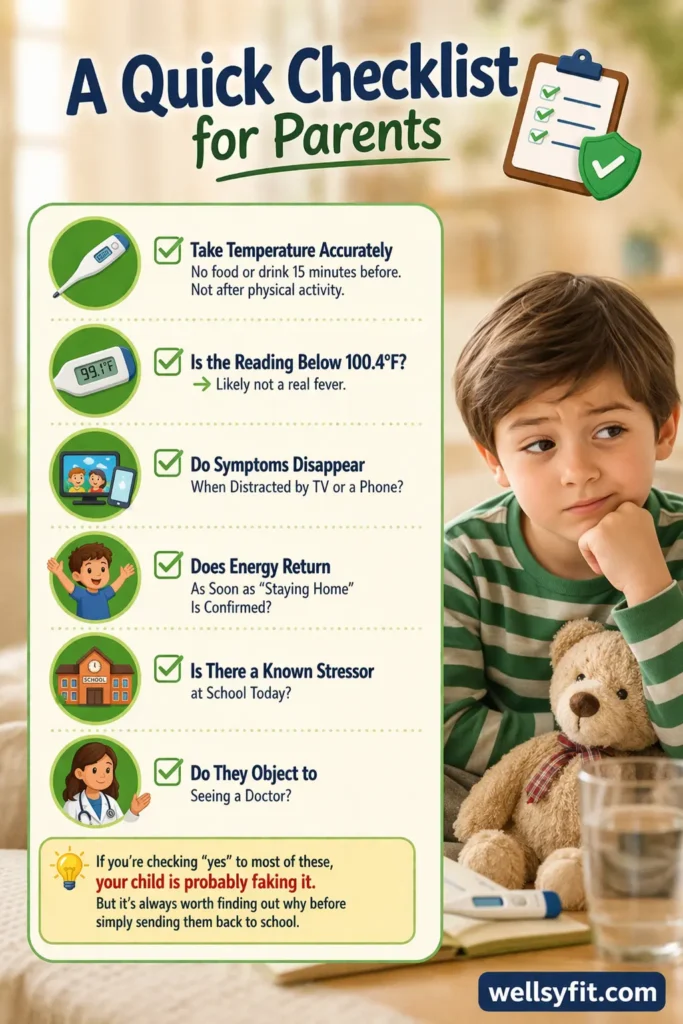
Use this when you’re unsure:
- Take temperature accurately (no food/drink 15 min before; not after physical activity)
- Is the reading below 100.4°F? → Likely not a real fever
- Do symptoms disappear when distracted by TV or a phone?
- Does energy return as soon as “staying home” is confirmed?
- Is there a known stressor at school today?
- Do they object to seeing a doctor?
If you’re checking “yes” to most of these, your child is probably faking it. But it’s always worth finding out why before simply sending them back to school.
Final Thought
A child faking a fever isn’t necessarily being manipulative — sometimes it’s the only way they know how to say “I’m not okay and I need a break.” The thermometer is your best tool for cutting through the performance, but the conversation that follows matters just as much as the reading on the screen.
Take the temperature. Check the symptoms. And then ask what’s really going on.
Disclaimer: Content on WellsyFit is for informational purposes only and does not replace professional medical advice. Always consult a healthcare provider.